Dual battery charging tips
30th Apr 2025 | 7 minutes to read
What battery charger do you need for your dual battery system? You might just need to install a dual battery isolator, or you might need a DC-DC charger for your 12v setup — especially if you're running a portable solar panel!
A reliable 12v system will help you power your fridge at camp, charge your devices, and keep you in the bush longer.
If we knew this trick years ago, it would have saved us thousands of dollars on new batteries. Many people are using the wrong type of battery charger for their battery and camp setup, which results in killing their batteries prematurely without even realizing it.
We’ll show you all the different battery chargers Shauno runs in his 4WDs, how they help make your dual batteries last as long as possible, and how to ensure you always have power at your campsite:

Shauno's got more than a few 12v systems under his belt, so he's run through some of them to help you find the right dual battery charger for your 12v setup!
Battery Charge Rates
Deep cycle batteries have a maximum amount of current and voltage they can handle during charging. Many people think charging a battery faster is better, but that’s not the case for every battery.
Each battery type and brand has specific voltage parameters for charging. Most lead-acid deep cycle batteries — like standard AGM or wet cell batteries — can only handle a maximum of 14.6v and 30 amps of charge. Charging beyond this can literally cook your battery.
Lithium batteries also have different specifications. You can find the charging specifications for your battery in its manual or by searching your battery model number online.
Dual Battery Isolator
Starting with the simplest and most basic form of dual battery charging — like in Shauno’s 47 Series Farm Truck — is the dual battery isolator.
When you turn on your 4WD, the charge from your alternator charges both your starter battery and your second battery. When you turn off your vehicle, the isolator disconnects the second battery, ensuring it doesn’t drain your starter battery. This means you can always start your vehicle, no matter how low your second battery gets.
Benefits of a Dual Battery Isolator:
- Affordable: The cheapest option for dual battery charging.
- Easy to Install: Great for DIY setups.
However, isolators are limited by how much charge your alternator produces and are only suitable for older vehicles with fixed voltage alternators.
Fixed Voltage Alternators
Fixed voltage alternators maintain a constant voltage that doesn’t fluctuate. Dual battery isolators turn on and off based on the voltage they receive, making them compatible with fixed voltage alternators.

Smart Alternators
Modern 4WDs have what is called a smart alternator that trickle charge your main battery based on how much voltage is in that battery, and as they trickle charge, the smart alternator turns on and off to put less strain on your engine and fuel consumption. Battery isolators do not work properly or effectively with smart alternators, so you will need another form of battery charger if your 4WD has one.
However, smart alternators do not work well with battery isolators because it initially recharges the starter battery at 14v, and then drops down to charge of around 13.3v because the starter battery is fully charged. Battery isolators turn on at 13.2v and turn off at 12.7v, so as your alternator changes voltage it will turn your battery charger on and off without fully charging your second battery

Isolator: The Verdict
Battery isolators are great for older vehicles but aren’t ideal for everyone. They lack voltage and current control, which can shorten the life of your deep cycle battery. If you have a newer vehicle or want to maximize your battery life, it’s worth upgrading to a DC-DC charger.
DC-DC Battery Charger
The main difference between a DC-DC charger and a battery isolator is that DC-DC chargers regulate the voltage and current going into your auxiliary battery.
Stage Charging
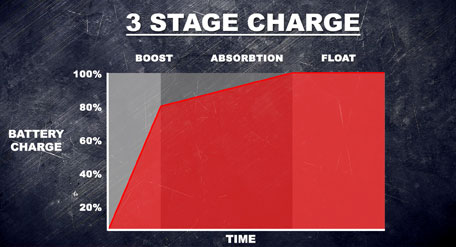
DC-DC chargers charge your batteries in three stages:
- Boost Stage: High current is used to fast-charge the battery to about 80%.
- Absorption Stage: Current decreases while voltage increases to fully charge the battery to 100%.
- Float Stage: A small amount of current and voltage is trickled into the battery to maintain a full charge, preventing overcharging and extending battery life.
What Size Charger Do You Need?
You should choose the fastest charger your battery can handle. While you can use a smaller charger, it will take longer to charge your battery.
For example:
- If you have an AGM battery that can handle 14.6v and 30 amps, you should use a charger rated for 25-30 amps.
- If you have two AGM batteries, your battery bank can handle 60 amps, so you could use a 50-amp DC-DC charger.
DC-DC Charger: The Verdict
We recommend DC-DC chargers for any dual battery setup. They are safer, more efficient, and maximize battery life. The only downside is that most DC-DC chargers don’t include a monitor for your 12v performance. However, they give you peace of mind knowing your battery will always be full and healthy when you arrive at camp.
12v Management System
Imagine driving your 4WD without a fuel gauge — you might risk a short trip to the shops, but you wouldn’t risk a big trip. The same logic applies to your 12v setup. Without a battery monitor, you can’t confidently rely on your system for longer trips.
Shauno’s 80 Series, Sooty, is equipped with a battery monitoring system for his dual battery setup. His monitor functions like a 30-amp DC-DC charger while also displaying battery percentage, charge rate, and other metrics.
What Gets Monitored?
Battery monitors typically display:
- Battery Charge Level: Percentage and estimated hours of charge remaining.
- Amp Draw: How many amps your accessories are consuming.
- Charge Input: How much charge is coming from solar panels or your alternator.
Basic Voltage Monitors
If you have a basic voltage monitor, here’s a reference chart for AGM battery charge levels:

Once your AGM battery drops to 12.0v, it’s 50% discharged and needs to be recharged immediately to avoid damage. At 10.0v, the battery is flat and, while it can be recharged, it will never perform as well as before.
Working With Solar
Solar controllers come in two types:
- Pulse Width Modulation (PWM): Basic and affordable.
- Maximum Power Point Tracking (MPPT): More efficient and effective.
Solar panels are a great addition to your 12v setup. They work well with battery isolators, DC-DC chargers, or as a standalone charging option.
Solar Panel Options:
- Roof-Mounted Panels: Ideal for keeping your battery topped up at camp or when parked at home (just avoid parking in the shade).
- Portable Panels/Blankets: Can be placed in the sunniest spot at camp for optimal charging.
Lithium Batteries
Lithium batteries are more expensive upfront but offer long-term cost savings due to their durability and efficiency. If you use lithium batteries, ensure your DC-DC charger and solar controller are lithium-compatible.
The Setup for You
With the information provided, you should be able to decide on the best 12v setup for your needs:
Budget-Friendly Option
For older 4WDs, a battery isolator is an excellent choice. It provides a cost-effective solution for managing dual-battery systems, making it ideal for those looking to save money while maintaining functionality.
For Big Remote Trips
If you’re planning extended remote adventures, a DC-DC charger is the way to go. It ensures your auxiliary battery remains healthy and reliable, even under demanding conditions, giving you peace of mind during long trips.
Add Solar for Extra Charging
Enhance your setup by pairing either a battery isolator or a DC-DC charger with solar panels. This addition provides extra charging capability when your vehicle is parked, ensuring you always have sufficient power for your needs.